Message
from Achim Steiner, UN Under-secretary General
and UNEP Executive Director on the Occasion
of World Water Day 2008
Nature's Answers to
the Sanitation Challenge
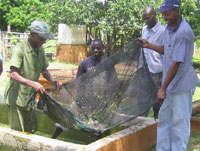
At a prison on the East coast of Africa,
in-mates are pioneering a sanitation project
that is working with nature to neutralize
human wastes.
The initiative, involving
the development of a wetland to purify sewage,
is expected to cost a fraction of the price
of high-tech treatments while also triggering
scores of environmental, economic and social
benefits.
Apart from wastewater
management, the project is to assess using
the wetland- filtered water for irrigation
and fish farming giving prisoners a new
source of protein or sold to local markets,
alternative livelihoods.
Part of the so-called
'black wastewater' with high concentrations
of human waste will also be used for the
production of biogas.
The biogas can be used
as a fuel for cooking, heating and lighting
thereby cutting electricity bills, saving
the prison service money and cutting emissions
from the 4,000-strong jail, including staff
and in-mates, to the atmosphere.
News of the project,
financed by the government of Norway and
the Global Environment Facility with support
from a wide range of partners including
Kenya's Coast Development Authority and
National Environment Management Authority
supported by the University of Dar es Salaam
in Tanzania and the University of Wageningen,
the Free University of Amsterdam and the
NGO 'Aqua-4-All' in the Netherlands, comes
as the globe marks World Water Day 2008
in the UN International Year of Sanitation.
The day and the year
are aimed at raising awareness and galvanizing
action to achieve the UN Millennium Development
Goals by 2015. These include halving the
proportion of people with no access to sanitation
from the current 40 per cent of the global
population or an estimated 2.6 billion people.
Sewage pollution, a
great deal of which ends up in coastal waters,
is estimated to cause four million lost
'man-years' annually in terms of human ill-health—equal
to an economic loss of $16 billion a year.
In many developed countries,
part of the answer over the past half century
has been found in ever more sophisticated,
multi-million dollar water treatment works.
But as the new project
at the Shimo la Tewa jail in the Kenyan
coastal city of Mombasa highlights there
are other, less costly ways of addressing
the same problem with important spin-offs.
The sewerage collection
and wetland purification system, plus labour
and construction costs and including upgrading
of sanitary facilities inside the prison
amount to some $110,000 or $25 per person
served—something of a bargain.
These do not include
benefits likely to accrue as a result of
diminished economic costs to the wider environment
- reductions of solids that can choke coral
reefs and nutrients that can increase risk
of de-oxygenated 'dead zones' alongside
cuts in bacterial pollution that can contaminate
shellfish and ruin someone's holiday in
a locale where tourism income is important
to the local economy.
Meanwhile the project
is likely to have benefits for wildlife
including birds and marine organisms.
Thus, in its own modest
way, it can play a part in assisting to
achieve the global target of reducing the
rate of loss of biodiversity by 2010.
The scheme is among a raft of projects being
undertaken under the Addressing Land-Based
activities in the Western Indian Ocean (WIO-LaB)
initiative which forms part of the UNEP-brokered
Nairobi Convention treaty—a regional seas
agreement.
It is hoped the lessons
learnt can be applied to other parts of
the world so that the multiple challenges
of sanitation and pollution can in part
be viewed through a nature-based lens.
The project is among
others also working with the coastal Ndlame
communities in Port Alfred South Africa
using ponds of natural algae to treat wastewaters
including sewage.
The algae, a freshwater
or marine organism, assist in de-toxifying
the pollutants and is then harvested as
a commercial fertilizer and protein-rich
animal feed.
The total project cost
here is around $188,000 with economic benefits
from utilizing treated wastewater and fertilizer
production offsetting the price by $50,000
a year.
Similar creative and
nature-based projects are being pioneered
on Pemba Island, Tanzania and in Dar es
Salaam.
The sustainability challenges
of the 21st century, including those that
relate to water and sanitation, demand more
intelligent and creative solutions than
perhaps have been deployed in the past.
Working with nature
rather than against it is part of that intelligent
decision-making that may prove a faster,
more cost effective and more economically
attractive way of achieving local and international
health and poverty goals.
+ More
European Commission
and UNEP Working Together for the Environment
The document highlights
EC-UNEP activities on issues related to
international environmental governance,
sustainable consumption and production,
global management of chemicals, protecting
the natural environment and biodiversity,
and water and sanitation.
It also discusses collaboration
between the EC and UNEP at the regional
level including: working in the developing
world, working in the Mediterranean, working
in Europe and post-conflict environmental
actions.
The brochure was distributed
by the European Commission at the 10th Special
Session of the Governing Council/Global
Ministerial Environment Forum in the Principality
of Monaco in February 2008.
The EC and UNEP
continue to work together to promote better
and more efficient world environmental governance,
to support sustainable development for all
through the execution of relevant UN decisions
and to ensure that environmental challenges
are met with decisive action all around
the world.